Market if Touched Order
The reactive one
A Market if Touched (MIT) order is an order type that is activated once the market reaches a specified trigger price. When triggered, it is executed as a market order, aiming for immediate execution at the best available price. This order type may be used when you want to buy or sell only after a certain price level is reached, without setting a fixed price limit.

What is a Market if Touched Order?
This order type is used to buy or sell a security once a specified trigger price is reached. When the market price touches the trigger price, the order becomes a market order and will be executed at the best available price. While the trade is executed immediately after the trigger price is hit, this order type does not guarantee a specific execution price.
Disclaimer
By selecting this order type, you prioritize execution speed over execution price. Using a market if touched order is generally acceptable when trading highly liquid securities during regular trading hours with low capital. However, it can be risky to use a market if touched order for trading more exotic securities because of larger spreads (the difference or gap that exists between two prices).
Key Features
Conditional Execution
- A market if touched order is designed to be executed as quickly as possible at the current market price once your trigger hits.
- For this type of order, the focus primarily lays the on the level you enter your trigger price.
Price Acceptance
- When placing a market if touched order, you agree to accept the best available price in the market at the time of execution.
- The actual execution price may be different from the last traded price due to market fluctuations, especially in volatile markets.
How does it work?
After you place a market if touched order, an executing broker sent your market order to the relevant exchange or market where the security is traded.
Buy Order
If the order is to buy, and the trigger is activated, the market order will be matched with the lowest available ask price at that moment.
Sell Order
If the order is to sell, and the trigger is activated, the market order will be matched with the highest available bid price at that moment.
Example:
You want to place a Market if Touched (MIT) order to buy 300 shares of XYZ, with a trigger price of €18.
At the time of placing the order, XYZ is trading at €20 per share. Your MIT order will only be activated if the market price drops to €18 or lower. Once triggered, it becomes a market order, and your broker will attempt to buy the shares at the best available ask prices.
Suppose a seller offers 300 shares at €18. In that case, your entire order is executed at that price.
If, however, only 100 shares are available at €18, and the next best offer is 200 shares at €19, the order will be partially filled at €18 and the remainder at €19.
Since MIT orders become market orders once activated, they may be executed across multiple price levels, depending on market liquidity at the time of execution.
The order is executed at the best available price(s) in the order book until the entire order is filled. If there is not enough liquidity at the best price, the order will continue to be filled at the next best prices until the entire amount is executed.
Advantages and disadvantages
Advantages
Disadvantages
- Immediate Execution:
A Market if Touched (MIT) order is executed as soon as the trigger price is reached. This allows for fast execution, which may be important in time-sensitive trading situations.
- Lack of Price Control:
Once triggered, the order becomes a market order. This means you may not know in advance at which price the trade will be executed.
- Automation:
The order is triggered automatically once the specified price is reached, removing the need for constant market monitoring.
- Potential for Slippage:
The executed price may differ from the trigger price, especially in volatile or less liquid markets. This can lead to less favorable outcomes than expected.
- Liquidity Utilization:
In liquid markets, this order type can result in fast and reliable execution at prices close to the trigger level.
- Partial Fills:
The executed price may differ from the trigger price, especially in volatile or less liquid markets. This can lead to less favorable outcomes than expected.
Submitting a Market if Touched Order via LYNX
LYNX+ The Market if Touched order type is not available within LYNX+. If you are looking for similar functionality, please refer to the FAQ section for possible alternatives. You can also explore our other trading platforms to see how and where a Market if Touched order can be submitted.
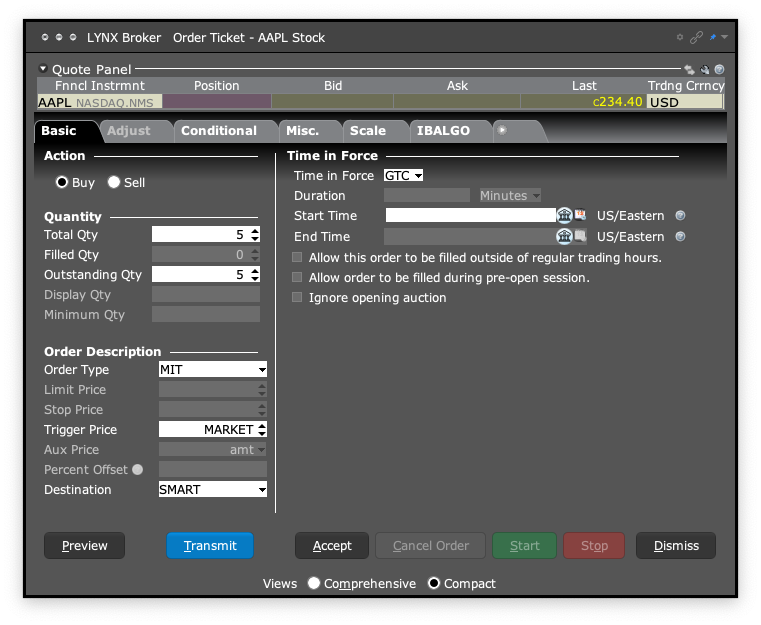
After logging in to Trader Workstation, open the order ticket by clicking on Order in the top left corner.
If you already have a specific security selected, the platform will automatically generate an order ticket for that instrument. You can change the underlying by entering the name, ticker symbol, or ISIN in the Financial Instrument field at the top of the ticket.
Next, select whether you want to buy or sell, enter the quantity, choose the destination, and set the time in force.
To select this order type, choose MIT from the Order Type dropdown menu.
You can review your order by clicking on Preview in the bottom left of the order ticket. To close the preview without submitting the order, click on Close. When you are ready to place the order, click Transmit.
To search for a product, tap the Search icon in the top right corner. Enter the name, ISIN, or ticker symbol. Tap a search result to open the product page.
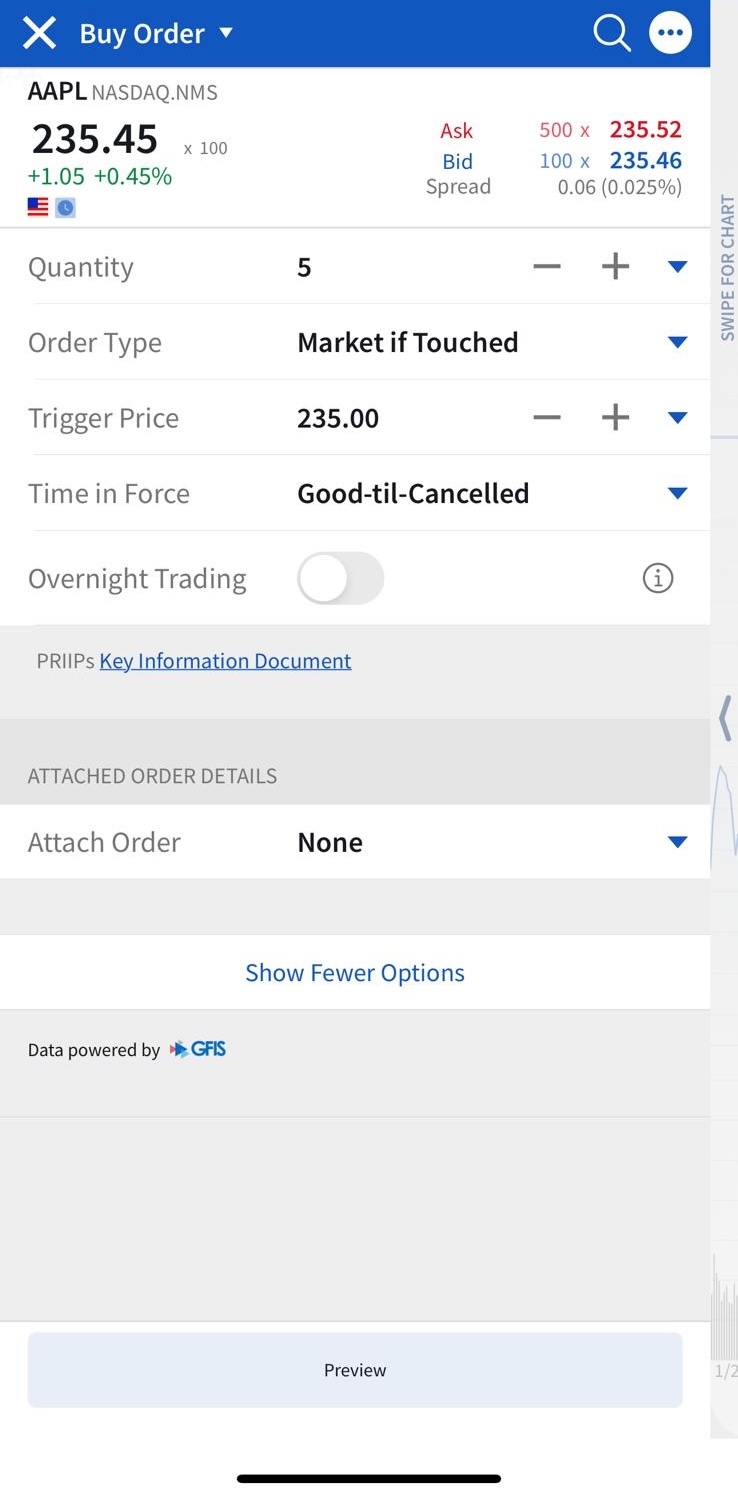
By tapping on Sell or Buy, you will open the order ticket.
Enter the quantity and set the validity period of your order under Time in Force. Select Market if Touched (MIT) as the order type.
Before submitting the order, you can review the order details by tapping the Preview or Calculator icon in the bottom right.
To place the order, swipe right on the Slide to Submit Sell or Buy button.
Tips before submitting a Market if Touched Order
When placing a Market if Touched (MIT) order, it is important to consider a few key points to help ensure proper execution and to limit unexpected outcomes.
Liquidity
Make sure the asset you are trading has sufficient liquidity.
Higher liquidity often results in tighter bid-ask spreads and reduces the risk of price impact when the order is executed.
For larger orders, keep in mind that execution may happen in parts and at varying prices.
Timing
MIT orders are generally best placed during regular trading hours, when liquidity tends to be highest.
Placing orders outside of these hours can lead to less favorable execution prices.
It is also advisable to avoid submitting MIT orders during major economic announcements or earnings releases, as these events can cause rapid and unpredictable price movements.
Monitoring
The bid-ask spread is the difference between the highest price buyers are willing to pay and the lowest price sellers are willing to accept.
A wider spread can increase the cost of execution. It is important to monitor the spread and consider its effect on your order.
FAQ
Will my MIT order be executed if the market is closed?
No, market orders, including those triggered by a Market if Touched (MIT) order, can only be executed during regular market hours.If you place a MIT order after the market has closed, it will remain inactive until the market opens.
If the trigger price is reached outside of market hours, the order will be activated but the attached market order will be queued and executed at the next market open.
What is the difference between a MIT and a LIT order?
The main difference between a Market if Touched (MIT) order and a Limit if Touched (LIT) order lies in how the order is executed once the trigger price is reached.
A MIT order activates a market order, which is executed immediately at the best available price.
A LIT order activates a limit order, which is only executed at the specified limit price or better.
As a result, a MIT order prioritises execution speed, while a LIT order prioritises price control. This difference also leads to different advantages and risks depending on market conditions and liquidity.
What is the difference between a MIT and a Market order?
The main difference between a Market if Touched (MIT) order and a regular Market order is the condition for execution.
A Market order is executed immediately at the best available price once submitted.
A MIT order, on the other hand, is only activated when the market reaches a specified trigger price. Once this condition is met, the MIT order becomes a Market order and is executed as soon as possible.
What is the difference between a MIT and a STP order?
The difference between a Market if Touched (MIT) order and a Stop (STP) order depends on the direction of the trigger price in relation to the current market price and the intended trading strategy.
When placing a buy order, a stop order is typically used if the trigger price is higher than the current market price. This is often done when a trader wants to buy once the price shows upward momentum. A MIT order, on the other hand, is used when the trigger price is lower than the current market price, allowing the trader to buy if the price drops to a more favorable level.
For a sell order, a MIT order is used if the trigger price is higher than the current price. This allows a trader to sell when the price rises to a certain level. If the trigger price is lower than the current market price, a stop order is more appropriate, often used to limit potential losses if the price declines.
In both cases, once the trigger price is reached, the order becomes a market order and will be executed at the best available price.
When could I consider to use a MIT order?
A Market if Touched (MIT) order can be useful when you want to buy or sell a security only after the price reaches a specific level, and you prioritise fast execution once that condition is met. This order type allows you to enter or exit a position based on market movement, without needing to monitor prices continuously.
For example, you might use a MIT order to buy if you expect the price to temporarily decline before recovering. Similarly, you could use a MIT order to sell if the price reaches a predefined target, allowing you to lock in potential gains.
Can I cancel a MIT order after it has been placed?
Yes, you can cancel a Market if Touched (MIT) order at any time, as long as the trigger price has not yet been reached. Once the trigger is activated and the order becomes a market order, cancellation is no longer possible.
Explore other order types

Market Order
Order Types
A market order is an instruction to buy or sell a financial instrument as quickly as possible at the best available price on the exchange. It prioritises execution speed over price control.
Learn more about this order type
Limit Order
Order Types
A limit order is an instruction to buy or sell a financial instrument at a specified price or better. It provides price control, but execution is only possible if the market reaches the set limit price.
Learn more about this order type
Stop Order
Order Types
A stop order is activated once a specified stop price is reached. It then becomes a market order to buy or sell the financial instrument.
Learn more about this order type
Stop Limit Order
Order Types
A stop-limit order is a type of order used to buy or sell a security when the user-specified stop gets triggered.A stop-limit order is triggered once a specified stop price is reached. After activation, it becomes a limit order at the user-defined limit price.
Learn more about this order type
Trail Order
Order Types
A trail order automatically adjusts the stop price by a fixed amount or percentage as the market price moves, helping to follow upward or downward trends.
Learn more about this order type
Trail Limit Order
Order Types
A trail limit order adjusts the stop price by a fixed amount or percentage as the market moves. Once the stop price is reached, a limit order is placed at the predefined limit level.
Learn more about this order type
Limit if Touched Order
Order Types
A Limit If Touched order is activated when the market reaches a predefined trigger price. Once triggered, it becomes a limit order at the user-specified price.
Learn more about this order type
Bracket Order
Order Types
A Bracket Order combines three orders: an initial buy or sell order, a take-profit order, and a stop-loss order. Once the initial order is executed, the system automatically places the two opposite orders to manage risk and potential profit.
Learn more about this order type